Tuesday, September 30, 2014

Is Alexander Truly Great?

Maggie Gardner
September 30, 2014
Block B
Alexander the Great

1. Does Alexander deserve be called great?

      I think that Alexander does deserve to be called great because he was a great military leader, he conquered many areas, he is known as a philosophical idealist, and he also united man - kind.
He was considered a great military leader because his way of attack is well known to this day, the phalanx method of attack.  The phalanx method was a army that consisted of sixteen men across and sixteen men deep and was almost always a given way to win a battle.  Alexander got all of his military tactics from his father who originally got them from the Epiminondas.  His army had 40,000 soldiers and never more than that.  He kept his army small because he thought speed and mobility were more important than anything else that an army could possess.  Alexander made sure his men were well fed and well paid at all times and made his army strive to win every battle.  He also dressed like his soldiers and spent time with them to earn motivation and loyalty.


            Alexander also deserves to be called Great because he conquered many areas that people, such as, his father and others failed at conquering so many times before.   His most rewarded area conquered was Persia.  This was because Persia was an area that many countries wanted to overtake and Alexander was the only successful taker.  He also conquered Egypt, India, and some parts of Asia.  The areas conquered by Alexander were a great addition to the Macedonian society and eventually helped Alexander unite man -kind.
            One of the most important actions done by Alexander was uniting man - kind.  He stretched Greece all the way to India resulting in his creation of the Hellenistic Kingdom or Hellenistic Period.  The Hellenistic Period lasted from 323 B.C. to 31 B.C.  This happened because Greece was becoming weak and Alexander noticed and wanted to make a change in Greece.


            Alexander was known as a philosophical idealist.  Philosophy back in Alexander’s time was very popular and one of the most studied fields in Ancient Greece.  Alexander was taught by Aristotle who was one of the most popular and well educated philosophers of this time and to this day.  Alexander was taught at the school of Mieza, which had Aristotle as a teacher as well as other well known teachers.  He was also very educated in morals and politics of his time.

2. What can one learn about the values of a society based on their views of greatness?
           
            By looking at a certain society and what they think is great, it can show us what type of society they are.   Macedonia’s society was great because they viewed Alexander’s beliefs as being great.  Alexander’s army led Macedonia to victory time after time letting the society believe that a great army is necessary and is great for a society
A society’s values can tell you a lot about their views of greatness.  By a society putting most effort into budgeting, military, fairness, and education you can tell what types of values the society has.
            If a society is based on budgeting and financial needs, this society has the values of being a wealthy society, ruthless society, smart, reliable, efficient, positive, inspiring, and a respected society. 
            A society based on military is a strong society, independent, brave, athletic, innovative, committed, hard headed, stubborn, and a consistent society.
A society based on fairness will possess values such as being a nurturing society, open minded, creative, fun loving, and a more efficient society.
            A society that puts most effort into education will be a smart society, knowledgeable, positive, educated, courageous, and an optimistic society.
            A well rounded society that puts an equal effort into everything that they think is great will be a very successful and ideal society, that possesses many core values.


3. Do time and distance impact someone’s popular perception?
            Over time, I believe it is possible for people to change their perception about a certain leader.  Their perception can change from thinking that a leader was terrible during his time but great in looking at the big picture or change from being great during his time but terrible in looking at the big picture.
            During Alexander’s time some people thought Alexander was great but most thought he was awful.  Most of Alexander’s people thought he worried too much about other areas and not about their own area.  Alexander made policies about a different country other than his own, such as Persia.  This made most people gain a hatred towards him during the time he ruled.   However, we now know that Alexander was a great leader who paid attention to his own country as well as looked out for others.  Looking at history, people’s perception about Alexander has changed from being a terrible leader to being a great leader.
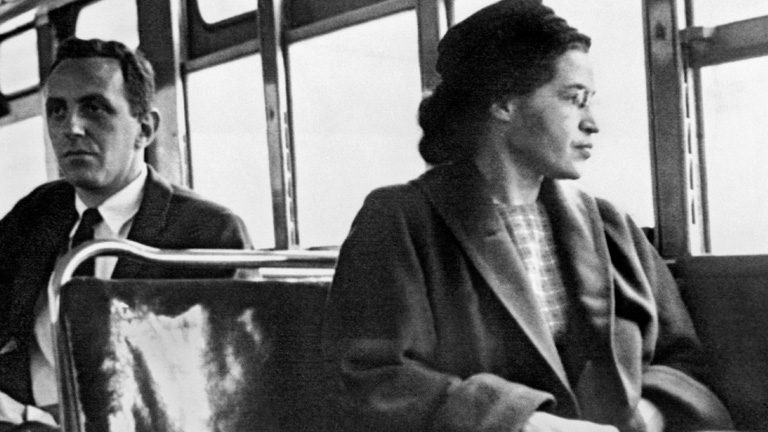
Rosa Parks would be another example of a person whos way of life was hated by many people of her time, but is appreciated by most people of current time.  Rosa Parks took a stand because of her race and age and sat in the front of the bus, which was reserved for the white people.  This action caused many white people to gain an even stronger hatred for African Americans.  Although white people hated Rosa Parks after she sat in the seat of whites, African Americans gained appreciation for her taking a stance.  Even though at the time Rosa Parks was hated, if it was not for her the United States might still be segregated.  Rosa Parks was one of the starting figures to lead our country into the Civil Rights Movement.  People’s perception of Rosa Parks has changed largely from a strong hatred to a great appreciation.


MLA Works Cited:
-       "How "Great" Was Alexander? [P.1]." How "Great" Was Alexander? [P.1]. N.p., n.d. Web. 22 Sept. 2014.
-       "Alexander and Aristotle." Alexander the Great and Aristotle. N.p., n.d. Web. 22 Sept. 2014.
-       "Hellenistic Greece." History.com. A&E Television Networks, n.d. Web. 22 Sept. 2014.
-       "Alexander the Great - Heroic Villain or Villanous Hero?" - Classical Studies. N.p., n.d. Web. 24 Sept. 2014.
-       "Alexander the Great – the Greatest Leader of All Time?" Military History Monthly. N.p., n.d. Web. 25 Sept. 2014.
-       "Examples of Core Values." YourDictionary. N.p., n.d. Web. 25 Sept. 2014.
-       Tarn, W.W. Hellenistic Military & Naval Developments. New York: Biblo and Tannen, 1966. Print.
-       Vivante, Bella. Events That Changed Ancient Greece. Westport, CT: Greenwood, 2002. Print.
-       "Alexander the Not so Great." BBC News. N.p., n.d. Web. 25 Sept. 2014.


Alexander The Great


Alexander the Great 

1. Does Alexander deserve to be called "Great"?

          Alexander III of Macedon also well known as Alexander the Great was a King of the Ancient Greek Kingdom of Macedon. Alexander received the epithe from the Romans who admired him. Alexander took the role of his father Phillip after he was stabbed by one of his bodyguards in 336 B.C. at a wedding banquet. Alexander was trained in Philosophy by Aristotle; he was his classical Greek teacher when he was in school at Miezaat at the young age of 13. Alexander established a city and led for thirteen years, he perfected Macedonia military style the phalanx. He took a 50,000 person army on a 12 year march across the continent and conquered lands unknown and unseen by the greeks. Alexander conquered the Persian Empire, including Syria, Phoenicia, Judea, Gaza, Egypt, Bactria, and Mesopotamia and extended his own empire as far as western india. Alexander did a lot in such a short period of time of 13 years, he died at the battle of Babylon. 


2. What can one learn about the values of society based on their views of greatness?

          One can learn about the values of society based on their views of greatness is that if you want to be viewed as great you can't be look bad, you want your society to look good and appeal good just like macedonia did. The reason macedonia is so great is because for starters it was the birth of alexander the great and that looked really good over time because of everything alexander accomplished. I think that many values of society are viewed on how great they are by what the did and how the helped society. 

3. Do time and distance impact someone's popular perception?

           Time and distance impact peoples popular perception definitely because over time people can form different opinion, and they have time to develop thoughts on it and think about if what they did was great for them of if it wasn't good and it didn't help. Over time people can see if what someone did helped the community or things that that or didn't and that leads me to think that yes, time really does impact peoples perception. A good example of someone who became great over time is William Shakespeare, he became famous after he passed. Throughout Williams lifetime he wrote many plays that are still watched today and still talked about. Although his plays are very popular today, william died as just another play-wrighter, and become very known in the mid century. 


Work Cited

"Alexander the Great." Ushistory.org. Independence Hall Association, 12 July 1942. Web. 22 Sept. 2014. <http://www.ushistory.org/civ/5g.asp>.

"Alexander the Great (Alexander of Macedon) Biography." Alexander the Great (Alexander of Macedon) Biography. N.p., 17 Feb. 2001. Web. 22 Sept. 2014. <http://www.historyofmacedonia.org/AncientMacedonia/AlexandertheGreat.html>.

"Alexander the Great." History.com. A&E Television Networks, n.d. Web. 22 Sept. 2014. <http://www.history.com/topics/ancient-history/alexander-the-great>.

"Alexander the Great." Ushistory.org. Independence Hall Association, n.d. Web. 24 Sept. 2014. <http://www.ushistory.org/civ/5g.asp>

"How "Great" Was Alexander? [P.1]." How "Great" Was Alexander? [P.1]. N.p., n.d. Web. 24 Sept. 2014. <http://www.utexas.edu/courses/citylife/readings/great1.html>.

"Pothos.org." - Introduction to Alexander the Great. N.p., n.d. Web. 24 Sept. 2014. <http://www.pothos.org/content/index.php?page=introduction-to-alexander>.

Bio.com. A&E Networks Television, n.d. Web. 27 Sept. 2014. <http://www.biography.com/people/william-shakespeare-9480323>.

  
Crockett Worthington   
Mr. Ward
B Block History


                                 The Greatness of Alexander

 1.) Does Alexander deserve to be called "great"?

      Alexander the Great can be described by many people in may different ways, and being great is one of them. He was great because he accomplished feats in the Roman military, he had great knowledge of strategy, and his leadership skills where genius. Alexander the Great was born of King Philip of Macedonia and is known around the world in today's society as being a great ruler.
      In the time of Rome war was not a choice, but a lifestyle. If one was courageous in war and defeated an enemy in battle they gained respect and power. At age 20 in the year 334 B.C. Alexander began to make a name for himself by riding out with his fathers army of 43,000 infantry and 5,000 calvary across the Hellespont in Asia, this expedition is thought by Colette Hemingway, a Greek and Roman historian at the Metropolitan Museum of Art, to be "The most formidable expedition ever to leave Greece". Alexander was the first Macedonian to lead his army onto Asiatic soil. After this expedition he then set his eyes on Persia, one of the largest and most fierce armies known to the world at this time. Persia had an army with hundreds of thousands of men and was known for being brutal and fierce, and were feared by every city-state across Europe and the Middle East. Alexander brought an end to the legendary Persian Empire in a total of 10 years. Alexander once said,"I am not afraid of an army of lions led by a sheep; I am afraid of an army of sheep lead by a lion", Alexander understood that an army is nothing without a courageous and strategic leader, even if the army itself is stronger than all.
     In a world in which everyone fights equally with a shield and a sword, the infantry becomes pawns, the calvary becomes knights, and the result of the war relies on the leader strategizing the next move. Alexander the Great was the type of leader that kept three moves ahead of his opponent at all times. He planned for error and adjusted for success, and part of this was because of lessons he learned as a young man. Since his birth, Alexander was tutored by the best teachers that could be found due to his royalty, and one of these tutor's name was Aristotle. Aristotle is known today as being one of the greatest minds ever known to mankind, and his philosophical ideas are still around today. Even thought Aristotle taught Alexander the Great about philosophy and how to "think out side of the box" no one quite knows exactly how Alexander the Great received his brilliant strategic insight that helped him win many important battles. We do know however that he used the same tactic as the Spartans, called the Phalanx tactic, but he used this tactic on a much larger scale. Many leaders around the world in 334 B.C. and even in 2014 A.D. do not have the strategic strengths as Alexander. One of his most known tactics was assembling his units in phalanx and other formations in order to make his numbers appear smaller than they actually were. This tactic made the enemy under estimate the size of the invaders therefor exposing themselves to the massive army of Alexander the Great.
This picture shows the Roman version of the Phalanx tactic


     Alexander was an unwavering force fighting valiantly and proving himself in battle time and time again. He not only had people admire him, but most of all he had the respect of many nations and people around the world. He gained this respect around the globe by conquering city-state after city-state and tearing down empire after empire for the good of his nation. He lead his army into countless battles and lead them to victory against the massive Persian Empire. Although his troops respected him as a conqueror, they did not think of him as a hospitable leader. The soldiers of Alexander's army were not fond of him because he appointed new commanders and generals from previously conquered lands and lead his army across the treacherous Makran dessert. Although the exact reason why Alexander the Great lead his army across this terrible desert is unknown, many historians speculate that he was either attempting to save the supplies gathered in his previous campaign in India or he was going to originally meet another fleet with more basic supplies for his army. Either way the journey resulted in the deaths of about 12,000 soldiers and a tarnished reputation for the great leader. Alexander did what he thought was necessary at the time just like any other great leader has done in their time of hardships. 
A statue of Aristotle (mentioned in the passage above)

The image shown above depicts the treacherous Makran Dessert

     A great ruler is measured by results and accomplishments, and not if one is liked by his or her peers. Alexander the Great was great because of his military accomplishments, strategic genius, and leadership capabilities. Through out his short time of leading Macedonia he conquered more land than any leader in the history of the earth before him, tore apart the Persian empire, and made himself a legend all in the time of twelve years. The world will remember the legacy of Alexander the Great and his great empire so long as we remember what true greatness means to us.

2.) What can one learn about the values of society based on their views of greatness? 
     
     In the time of Alexander the Great, society valued honor, courage, and power. If one is capable of conquering another city-state or large Empire then they will be granted with respect and fear. In the time period of Alexander there is little to no line between respect a fear, for if one fears that a great empire such as Macedonia can easily take their free will and life then respect is inevitable. To be "great" one must thrive to be thought of as courageous and powerful. Power is everything, for if one is in possession of power then they are in possession of leverage against another city-state or empire.

3.)     Do time and distance effect one's popular perception?

    In the modern world distance does not effect one's popular perception, for we have globalization. Globalization is the transfer of knowledge over fast periods of time, this can include the news, social media, or even phone calls. Time changes one's popular perception by deluding the facts that are not as significant and by looking back on the event from a chain reaction point of view and how it effects the present. For example, the Boston Tea Part was just a protest by colonist who were upset because of the lack of representation that they had in their government. But today we see this as an event that shaped the revolutionary war, which changed America forever. As humans we cannot just ignore our current lives and look upon an event with a biased opinion and see the simplicity of it without its effect on our lives. Therefor we automatically perceive past events as "great" or memorable because they are like a puzzle piece to our current lives that we experience now.


Works Cited
"Alexander in the Gedrosian Desert." Alexander the Great: The Gedrosian Desert. Livius.org. Web. 30 Sept. 2014.
"Alexander the Great – the Greatest Leader of All Time?" Military History Monthly. Military-history.org. Web. 30 Sept. 2014.
"Alexander the Great." History.com. A&E Television Networks. Web. 29 Sept. 2014.
"Alexander the Great." Princeton University. Web. 30 Sept. 2014.

Halil, Sikander. "Pothos.org." - Alexander and the Makran Desert. Pothos.org. Web. 30 Sept. 2014.