Maggie Gardner
September 30,
2014
Block B
Alexander the Great
1.
Does Alexander deserve be called great?
I think that Alexander does deserve to be called great because he
was a great military leader, he conquered many areas, he is known as a
philosophical idealist, and he also united man - kind.
He was considered a great military leader because
his way of attack is well known to this day, the phalanx method of attack.
The phalanx method was a army that consisted of sixteen men across and
sixteen men deep and was almost always a given way to win a battle.
Alexander got all of his military tactics from his father who originally
got them from the Epiminondas. His army had 40,000 soldiers and never more
than that. He kept his army small
because he thought speed and mobility were more important than anything else
that an army could possess. Alexander made sure his men were well fed and
well paid at all times and made his army strive to win every battle. He also dressed like his soldiers and spent
time with them to earn motivation and loyalty.

Alexander also deserves to be called
Great because he conquered many areas that people, such as, his father and
others failed at conquering so many times before. His most rewarded area conquered was
Persia. This was because Persia was an
area that many countries wanted to overtake and Alexander was the only
successful taker. He also conquered
Egypt, India, and some parts of Asia.
The areas conquered by Alexander were a great addition to the Macedonian
society and eventually helped Alexander unite man -kind.
One of the most important actions
done by Alexander was uniting man - kind.
He stretched Greece all the way to India resulting in his creation of
the Hellenistic Kingdom or Hellenistic Period.
The Hellenistic Period lasted from 323 B.C. to 31 B.C. This happened because Greece was becoming
weak and Alexander noticed and wanted to make a change in Greece.
Alexander was known as a
philosophical idealist. Philosophy back
in Alexander’s time was very popular and one of the most studied fields in
Ancient Greece. Alexander was taught by
Aristotle who was one of the most popular and well educated philosophers of
this time and to this day. Alexander was
taught at the school of Mieza, which had Aristotle as a teacher as well as
other well known teachers. He was also
very educated in morals and politics of his time.
2.
What can one learn about the values of a society based on their views of
greatness?
By looking at a certain society and
what they think is great, it can show us what type of society they are. Macedonia’s society was great because they
viewed Alexander’s beliefs as being great.
Alexander’s army led Macedonia to victory time after time letting the
society believe that a great army is necessary and is great for a society
A society’s values can tell you a lot about their
views of greatness. By a society putting
most effort into budgeting, military, fairness, and education you can tell what
types of values the society has.
If a society is based on budgeting
and financial needs, this society has the values of being a wealthy society,
ruthless society, smart, reliable, efficient, positive, inspiring, and a
respected society.
A society based on military is a
strong society, independent, brave, athletic, innovative, committed, hard headed,
stubborn, and a consistent society.
A society based on fairness will possess values
such as being a nurturing society, open minded, creative, fun loving, and a
more efficient society.
A society that puts most effort into
education will be a smart society, knowledgeable, positive, educated,
courageous, and an optimistic society.
A well rounded society that puts an
equal effort into everything that they think is great will be a very successful
and ideal society, that possesses many core values.

3.
Do time and distance impact someone’s popular perception?
Over time, I believe it is possible
for people to change their perception about a certain leader. Their perception can change from thinking
that a leader was terrible during his time but great in looking at the big
picture or change from being great during his time but terrible in looking at
the big picture.
During Alexander’s time some people
thought Alexander was great but most thought he was awful. Most of Alexander’s people thought he worried
too much about other areas and not about their own area. Alexander made policies about a different
country other than his own, such as Persia.
This made most people gain a hatred towards him during the time he
ruled. However, we now know that
Alexander was a great leader who paid attention to his own country as well as
looked out for others. Looking at
history, people’s perception about Alexander has changed from being a terrible
leader to being a great leader.
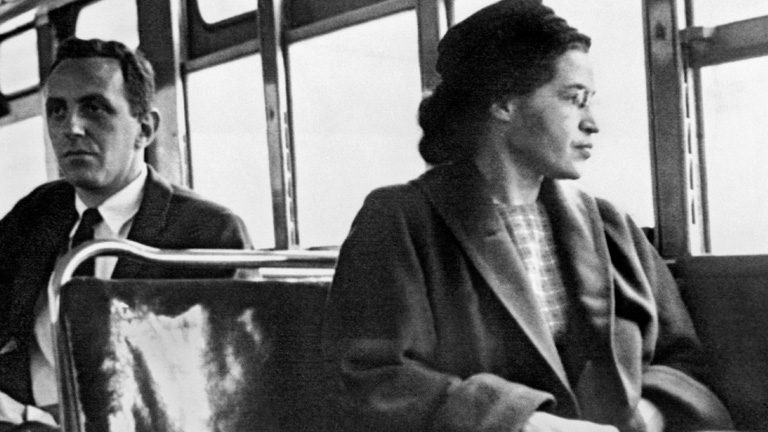
Rosa Parks would be another example of a person whos
way of life was hated by many people of her time, but is appreciated by most
people of current time. Rosa Parks took
a stand because of her race and age and sat in the front of the bus, which was
reserved for the white people. This
action caused many white people to gain an even stronger hatred for African
Americans. Although white people hated
Rosa Parks after she sat in the seat of whites, African Americans gained
appreciation for her taking a stance.
Even though at the time Rosa Parks was hated, if it was not for her the
United States might still be segregated.
Rosa Parks was one of the starting figures to lead our country into the
Civil Rights Movement. People’s
perception of Rosa Parks has changed largely from a strong hatred to a great
appreciation.
MLA
Works Cited:
-
"How "Great" Was Alexander?
[P.1]." How "Great" Was Alexander? [P.1]. N.p., n.d. Web.
22 Sept. 2014.
-
"Alexander and Aristotle." Alexander
the Great and Aristotle. N.p., n.d. Web. 22 Sept. 2014.
-
"Hellenistic Greece." History.com.
A&E Television Networks, n.d. Web. 22 Sept. 2014.
- "Alexander
the Great - Heroic Villain or Villanous Hero?" - Classical Studies.
N.p., n.d. Web. 24 Sept. 2014.
-
"Alexander the Great – the Greatest Leader of
All Time?" Military History Monthly. N.p., n.d. Web. 25 Sept. 2014.
-
"Examples of Core Values." YourDictionary.
N.p., n.d. Web. 25 Sept. 2014.
-
Tarn, W.W. Hellenistic Military & Naval
Developments. New York: Biblo and Tannen, 1966. Print.
-
Vivante, Bella. Events That Changed Ancient
Greece. Westport, CT: Greenwood, 2002. Print.
-
"Alexander the Not so Great." BBC News.
N.p., n.d. Web. 25 Sept. 2014.

I like how you talked about Alexander uniting man kind, and making adjustments to Greece when he needed it. Loved the Rosa Parks comparison, I think she is a good example for you to use. I liked how you explained how she defended her race and stood up for herself and later on people started to respect her. Good Job Girl!
ReplyDeleteBy mentioning the phalanx tactic in the first paragraph, you brought a vivid idea to the reader's mind along with the picture. By bringingg Rosa Parks into the paper you made connections to something that all of America learns in school and talks about at least once a year. This brought not only attention to the essay, but also made it easier to make a personal connection with the subject. You said,"People’s perception of Rosa Parks has changed largely from a strong hatred to a great appreciation.", by stating this were you saying that Alexander the Great was hated, but now is loved like Rosa Parks?
ReplyDeleteIn question one you commented how he conquered many areas, do you think him being able to conquer so many areas was a good thing?
ReplyDeleteDid Alexander's reputation change from strongly hated back then to greatly appreciated now like Rosa Parks?
ReplyDeleteNice job on your blog post! I like how you included the fact that Alexander was able to conquer many areas that people, such as his father, were unable to take over. I also enjoyed how you gave many examples of different kinds of societies that value completely opposite ideas and qualities. How you included Aristotle's association with Alexander was very impacting, too, because philosophy was very important back in that time period as you stated in the first answer.
ReplyDeleteI like the idea that a society's view of greatness doesn't influence it as much as the society influences its' citizens views of greatness.
ReplyDeleteYes Crockett, I compared Rosa Parks in the same way as Alexander as being hated at his time but loved now.
ReplyDeleteYes mere, Alexander's reputation did change strongly from hated back then to greatly appreciated now.
ReplyDelete