Wednesday, October 1, 2014

Alexander the Not-So-Great

          Does Alexander deserve to have the epithet of "great"?

           
 Alexander was a king for Greece over the span of two years, then left on an eleven year conquest. He left a man named Antipater in charge with a minuscule army to fight an ongoing war. He was ruthless, showed no mercy, and almost constantly drunk, yet was romanticized as a hero. Why is this?
                Alexander the Great is (and was) credited with being the flame of the Hellenistic Period; spreading culture and civilization throughout his vast empire of southeastern Asia. Which was correct—but he once he had established his empire, he died abruptly and did not leave any governing structure for it. Therefore, following his death, his empire disintegrated. [Not to leave out that Alexander was not a brilliant military strategist, which he was, as well as his being known determination and courage. However, I still do not believe he deserves his epithet, despite being intelligent and a brilliant leader.]
             In the earlier years of Alexander’s conquest, he set out to follow what his father intended to do: conquer Persia. To paraphrase pages on this (Alexander the Great, by Robin Lane Fox): "He completely succeeded in his attempt, but not before allowing Darius (the ruler of Persia at that time) to regroup his army and create a much bigger bloodshed than necessary on both sides" (Fox 224-225). He [Alexander] was prone to drunken rampages and needlessly giving away the lives of his own men. When retreating on a path and heading a different way would have taken longer but prevented many deaths, he chose to continue through the desert and ended up with a smaller army in result.
            While chasing Darius and his army, Alexander began to adopt that of Persia’s culture and style, as well as claiming himself a god, enforcing that his soldiers begin to call him as one. He decided that he would then abandon the “veteran” soldiers on his conquest and integrate new, Persian soldiers into his army, much to the veterans' chagrin.
                 What this says about Alexander: in my opinion, he does not deserve the title of 'great,' because of his drunken, so-called superior demeanor, decisions, and attitude with his soldiers.

*****
                    What can one learn about values of society based on their views of greatness?

          Different societies view "greatness,"-- or a hero's legacy-- differently. In turn, what that says about about those societies is varied. For example, ancient Macedonia's values were different than that of Greece's: they put their empire before anything else, while Greece valued histories, sciences, and education generally above their empire. Alexander himself, as he carried forth his conquest over Asia, was taking the Macedonian name and expanding it [the empire], which started to improve the Macedonian army in itself. They came to value their strong, efficient military they hadn't previously had, and this said something new about them. Because this is what the Macedonians were now backing up (enforcing), this tells us that they were a somewhat strong, united people to protect themselves and their home. One can learn, simply from hearing the Macedonians had a high regard for their empire and military, what kind of people they were. This can go for any people: what they regard highest, "put their money behind," and in turn, that says something about them.
          For another example, the United States. We, as American citizens, generally value materialism. This says the U.S. values and collects more material items than other countries, and therefore a higher priority to maintaining, obtaining, and protecting those materialistic items. Which, compared to other places, makes Americans seem more material-based and therefore "greedy" or close-minded.

*****
                      Do time and distance impact someone's popular perception?

          I believe that yes, distance and time impact one's perception. The most obvious example here is Alexander the Great--while he was not (is not) deserving of his epithet, in my opinion, many choose to skim over the more unwanted, gruesome facts. After Alexander passed, many fables were spun about his greatness, his death, but they were all untrue. He never really became a mermaid, obviously! But many people choose to romanticize heroes (that lived and died long before they did), because it's so easy to enlargen or "puff up" someone to make them seem better than they actually are. It's quite common, not just for Alexander, but other nineteenth/twentieth century characters, such as Joseph Stalin. I make this comparison for several reasons; of course Stalin himself was not a good person internally, but he was extremely intelligent.
          To provide a brief background context on Stalin: he was appointed secretary for the Communist Party in 1922, and slowly started consolidating power so people would have to go to him for anything; once previous leader Lenin died, he basically had control over the Soviet government and signed a contract with Adolf Hitler. These two people, Alexander and Stalin, have almost nothing in common, except for being 'romanticized,' or thought of as a man who did nothing but help others, and a man who left a wake of complete terror and destroyed Russia.
          It's been about fifty-eight years since Stalin's reign, and since then, people have been realizing his true ruthless intentions, yet also how he formed Russia into a "world superpower," modernizing it and defeating Nazism. This can be said--in a different way--about Alexander. He lived about 2,300 years ago, killed people needlessly, constantly drunken and made terrible decisions--yet he also was the flame for the Hellenistic period, integrating cultures, and uniting Greece.


Works Cited
"Alexander Romance." Encyclopedia Britannica. N.p., n.d. Web. 24 Sept. 2014. <http://www.britannica.com/EBchecked/topic/14218/Alexander-romance>.
Ansari, Ali. "Alexander the not so Great: History through Persian eyes." BBC. N.p., 4 July 2012. Web. 19 Sept. 2014. <http://www.bbc.com/news/magazine-18803290>.
Bialo, Ellen. World History: Ancient and Medieval Eras. N.p.: n.p., 2014. ABC-CLIO eBook Collection. Web. 19 Sept. 2014. <http://ancienthistory.abc-clio.com/Search/Display/1185181?terms=alexander%20the%20great&webSiteCode=SLN_HANC&returnToPage=%2fSearch%2fDisplay%2f1185181%3fterms%3dalexander+the+great&token=3A678D1387C57B100F66A831B74121CA&casError=False>.
Fox, Robin Lane. Alexander the Great. New York: Penguin, 1986. Print.
Gandeto, J. S. "Differences Between Ancient Macedonians and Ancient Greece." History of Macedonia. N.p., n.d. Web. 24 Sept. 2014. <http://www.historyofmacedonia.org/AncientMacedonia/gandeto.html>.
"Joseph Stalin-Biography." Bio. N.p., n.d. Web. 25 Sept. 2014. <http://www.biography.com/people/joseph-stalin-9491723#communist-party-leader>.
Kohls, L. Robert. "The Values Americans Live By." ClareMontMckenna. N.p., n.d. Web. 29 Sept. 2014. 
Thayer, Bill. "Life of Alexander the Great." Penelope UChicago. N.p., n.d. Web. 22 Sept. 2014. <http://penelope.uchicago.edu/Thayer/E/Roman/Texts/Curtius/home.html>.

Worthington, Ian. "How 'Great' Was Alexander?" The Ancient History Bulletin (1999): n. pag. Print.


Alexander the Great Project

1) Does Alexander deserve to be called "Great"?

Alexander deserves to be called great in many ways, he was a young man when he became king but, he was "great" as people would say. Alexander to me is considered great because he was a great king and warrior. When Alexander became king his first objective was to strengthen his community. As a king he found many great treasures on his expeditions. One being he had found about half a billion dollars, this was more income of Athens in there 300 year age. Another good thing that makes him great was that he was very patient. Alexander wanted to kill Darius and take his crown, but before rushing headlong to him he was patient and secured his position in his plan. Another big reason for Alexander being so great was that he defeated many cities like Persia, India, and even the Indus River. His fathers plan he concluded and also made it better. Alexander is overall pretty great in my mind and i think he deserves his name. In the end of Alexander won many victories and kept fighting. He won spurs of wars and inherited a magnificent army with his greatness.


2) What can one learn about the values of society based on their views of greatness?

One can learn about the values of society based on their views of greatness by, the thought of life without the greatness, how would their life be if the greatness was gone? They can learn from that because they would think of how their life would be different and how their life would have changed overtime. Greatness in life and society is an important thing to live by because greatness brings you happiness. Macedonia was a great community and they lived in a great place they had feature they needed, It was ruled by Alexander the Great and taken over by the Ottoman Empire but imagine if Alexander never became king how would their greatness of society and values change without their wonderful, great king Alexander? 
Alexander died from fever on day 1 of the fever, it had just arrived. by day 9-10 he had passed away. The Macedonians king had passed away and was gone. It was a terrible time for their community. 


3) Do time and distance impact someone’s popular perception?

In the Pella region Alexander the Great the later king of Macedonia was born on July 20, 356 B.C. When his father died Alexander was wanted the throne to be his with any means necessary. The Macedonian army was garnered up with much support of Alexander. Back then this most likely gave him fame and affection because he was making his troops better which made his army better which made his community better and much more feared then when his father was ruling. In this time of 2014 this would cause controversy against our world and community. There would be many that say it was wrong and many who would say it was right, and i'm sure this happened back then too but in today's day people are picky and want perfection. So necessarily the time and distance do impact someones popular perception back then it was good and in the present now it would have many mixed emotions.


Citations:

"Alexander the Great." Ushistory.org. Independence Hall Association, n.d. Web. 19 Sept. 2014.
http://www.ushistory.org/civ/5g.asp

Wepman, Dennis. World Leaders Past & Present Alexander The Great. N.p.: Chelsea House, 1986. Print. (pg.81 & 87)

Bio.com. A&E Networks Television, n.d. Web. 22 Sept. 2014.
http://www.biography.com/people/alexander-the-great-9180468

"MACEDONIA." Macedonia Map / Geography of Macedonia / Map of Macedonia. N.p., n.d. Web. 24 Sept. 2014.
http://www.worldatlas.com/webimage/countrys/europe/mk.htm

"The Death of Alexander the Great, 323 BC." The Death of Alexander the Great, 323 BC. N.p., n.d. Web. 23 Sept. 2014.
http://www.eyewitnesstohistory.com/alexanderdeath.htm

"Alexander of Macedonia." Alexander of Macedonia. N.p., n.d. Web. 25 Sept. 2014.
http://www.sjsu.edu/faculty/watkins/alexandergreat.htm

Bennett, Matthew. The Hutchinson Dictionary of Ancient & Medieval Warfare. Chicago: Fitzroy Dearborn, 1998. Print.(p.11


Tuesday, September 30, 2014

Is Alexander Truly Great?

Maggie Gardner
September 30, 2014
Block B
Alexander the Great

1. Does Alexander deserve be called great?

      I think that Alexander does deserve to be called great because he was a great military leader, he conquered many areas, he is known as a philosophical idealist, and he also united man - kind.
He was considered a great military leader because his way of attack is well known to this day, the phalanx method of attack.  The phalanx method was a army that consisted of sixteen men across and sixteen men deep and was almost always a given way to win a battle.  Alexander got all of his military tactics from his father who originally got them from the Epiminondas.  His army had 40,000 soldiers and never more than that.  He kept his army small because he thought speed and mobility were more important than anything else that an army could possess.  Alexander made sure his men were well fed and well paid at all times and made his army strive to win every battle.  He also dressed like his soldiers and spent time with them to earn motivation and loyalty.


            Alexander also deserves to be called Great because he conquered many areas that people, such as, his father and others failed at conquering so many times before.   His most rewarded area conquered was Persia.  This was because Persia was an area that many countries wanted to overtake and Alexander was the only successful taker.  He also conquered Egypt, India, and some parts of Asia.  The areas conquered by Alexander were a great addition to the Macedonian society and eventually helped Alexander unite man -kind.
            One of the most important actions done by Alexander was uniting man - kind.  He stretched Greece all the way to India resulting in his creation of the Hellenistic Kingdom or Hellenistic Period.  The Hellenistic Period lasted from 323 B.C. to 31 B.C.  This happened because Greece was becoming weak and Alexander noticed and wanted to make a change in Greece.


            Alexander was known as a philosophical idealist.  Philosophy back in Alexander’s time was very popular and one of the most studied fields in Ancient Greece.  Alexander was taught by Aristotle who was one of the most popular and well educated philosophers of this time and to this day.  Alexander was taught at the school of Mieza, which had Aristotle as a teacher as well as other well known teachers.  He was also very educated in morals and politics of his time.

2. What can one learn about the values of a society based on their views of greatness?
           
            By looking at a certain society and what they think is great, it can show us what type of society they are.   Macedonia’s society was great because they viewed Alexander’s beliefs as being great.  Alexander’s army led Macedonia to victory time after time letting the society believe that a great army is necessary and is great for a society
A society’s values can tell you a lot about their views of greatness.  By a society putting most effort into budgeting, military, fairness, and education you can tell what types of values the society has.
            If a society is based on budgeting and financial needs, this society has the values of being a wealthy society, ruthless society, smart, reliable, efficient, positive, inspiring, and a respected society. 
            A society based on military is a strong society, independent, brave, athletic, innovative, committed, hard headed, stubborn, and a consistent society.
A society based on fairness will possess values such as being a nurturing society, open minded, creative, fun loving, and a more efficient society.
            A society that puts most effort into education will be a smart society, knowledgeable, positive, educated, courageous, and an optimistic society.
            A well rounded society that puts an equal effort into everything that they think is great will be a very successful and ideal society, that possesses many core values.


3. Do time and distance impact someone’s popular perception?
            Over time, I believe it is possible for people to change their perception about a certain leader.  Their perception can change from thinking that a leader was terrible during his time but great in looking at the big picture or change from being great during his time but terrible in looking at the big picture.
            During Alexander’s time some people thought Alexander was great but most thought he was awful.  Most of Alexander’s people thought he worried too much about other areas and not about their own area.  Alexander made policies about a different country other than his own, such as Persia.  This made most people gain a hatred towards him during the time he ruled.   However, we now know that Alexander was a great leader who paid attention to his own country as well as looked out for others.  Looking at history, people’s perception about Alexander has changed from being a terrible leader to being a great leader.
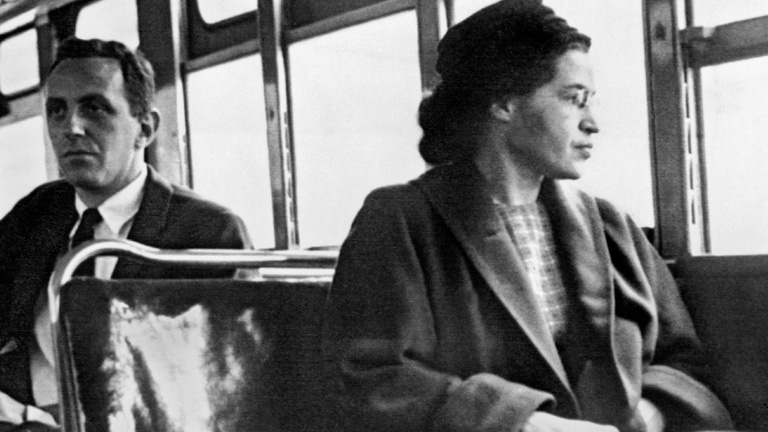
Rosa Parks would be another example of a person whos way of life was hated by many people of her time, but is appreciated by most people of current time.  Rosa Parks took a stand because of her race and age and sat in the front of the bus, which was reserved for the white people.  This action caused many white people to gain an even stronger hatred for African Americans.  Although white people hated Rosa Parks after she sat in the seat of whites, African Americans gained appreciation for her taking a stance.  Even though at the time Rosa Parks was hated, if it was not for her the United States might still be segregated.  Rosa Parks was one of the starting figures to lead our country into the Civil Rights Movement.  People’s perception of Rosa Parks has changed largely from a strong hatred to a great appreciation.


MLA Works Cited:
-       "How "Great" Was Alexander? [P.1]." How "Great" Was Alexander? [P.1]. N.p., n.d. Web. 22 Sept. 2014.
-       "Alexander and Aristotle." Alexander the Great and Aristotle. N.p., n.d. Web. 22 Sept. 2014.
-       "Hellenistic Greece." History.com. A&E Television Networks, n.d. Web. 22 Sept. 2014.
-       "Alexander the Great - Heroic Villain or Villanous Hero?" - Classical Studies. N.p., n.d. Web. 24 Sept. 2014.
-       "Alexander the Great – the Greatest Leader of All Time?" Military History Monthly. N.p., n.d. Web. 25 Sept. 2014.
-       "Examples of Core Values." YourDictionary. N.p., n.d. Web. 25 Sept. 2014.
-       Tarn, W.W. Hellenistic Military & Naval Developments. New York: Biblo and Tannen, 1966. Print.
-       Vivante, Bella. Events That Changed Ancient Greece. Westport, CT: Greenwood, 2002. Print.
-       "Alexander the Not so Great." BBC News. N.p., n.d. Web. 25 Sept. 2014.


Alexander The Great


Alexander the Great 

1. Does Alexander deserve to be called "Great"?

          Alexander III of Macedon also well known as Alexander the Great was a King of the Ancient Greek Kingdom of Macedon. Alexander received the epithe from the Romans who admired him. Alexander took the role of his father Phillip after he was stabbed by one of his bodyguards in 336 B.C. at a wedding banquet. Alexander was trained in Philosophy by Aristotle; he was his classical Greek teacher when he was in school at Miezaat at the young age of 13. Alexander established a city and led for thirteen years, he perfected Macedonia military style the phalanx. He took a 50,000 person army on a 12 year march across the continent and conquered lands unknown and unseen by the greeks. Alexander conquered the Persian Empire, including Syria, Phoenicia, Judea, Gaza, Egypt, Bactria, and Mesopotamia and extended his own empire as far as western india. Alexander did a lot in such a short period of time of 13 years, he died at the battle of Babylon. 


2. What can one learn about the values of society based on their views of greatness?

          One can learn about the values of society based on their views of greatness is that if you want to be viewed as great you can't be look bad, you want your society to look good and appeal good just like macedonia did. The reason macedonia is so great is because for starters it was the birth of alexander the great and that looked really good over time because of everything alexander accomplished. I think that many values of society are viewed on how great they are by what the did and how the helped society. 

3. Do time and distance impact someone's popular perception?

           Time and distance impact peoples popular perception definitely because over time people can form different opinion, and they have time to develop thoughts on it and think about if what they did was great for them of if it wasn't good and it didn't help. Over time people can see if what someone did helped the community or things that that or didn't and that leads me to think that yes, time really does impact peoples perception. A good example of someone who became great over time is William Shakespeare, he became famous after he passed. Throughout Williams lifetime he wrote many plays that are still watched today and still talked about. Although his plays are very popular today, william died as just another play-wrighter, and become very known in the mid century. 


Work Cited

"Alexander the Great." Ushistory.org. Independence Hall Association, 12 July 1942. Web. 22 Sept. 2014. <http://www.ushistory.org/civ/5g.asp>.

"Alexander the Great (Alexander of Macedon) Biography." Alexander the Great (Alexander of Macedon) Biography. N.p., 17 Feb. 2001. Web. 22 Sept. 2014. <http://www.historyofmacedonia.org/AncientMacedonia/AlexandertheGreat.html>.

"Alexander the Great." History.com. A&E Television Networks, n.d. Web. 22 Sept. 2014. <http://www.history.com/topics/ancient-history/alexander-the-great>.

"Alexander the Great." Ushistory.org. Independence Hall Association, n.d. Web. 24 Sept. 2014. <http://www.ushistory.org/civ/5g.asp>

"How "Great" Was Alexander? [P.1]." How "Great" Was Alexander? [P.1]. N.p., n.d. Web. 24 Sept. 2014. <http://www.utexas.edu/courses/citylife/readings/great1.html>.

"Pothos.org." - Introduction to Alexander the Great. N.p., n.d. Web. 24 Sept. 2014. <http://www.pothos.org/content/index.php?page=introduction-to-alexander>.

Bio.com. A&E Networks Television, n.d. Web. 27 Sept. 2014. <http://www.biography.com/people/william-shakespeare-9480323>.